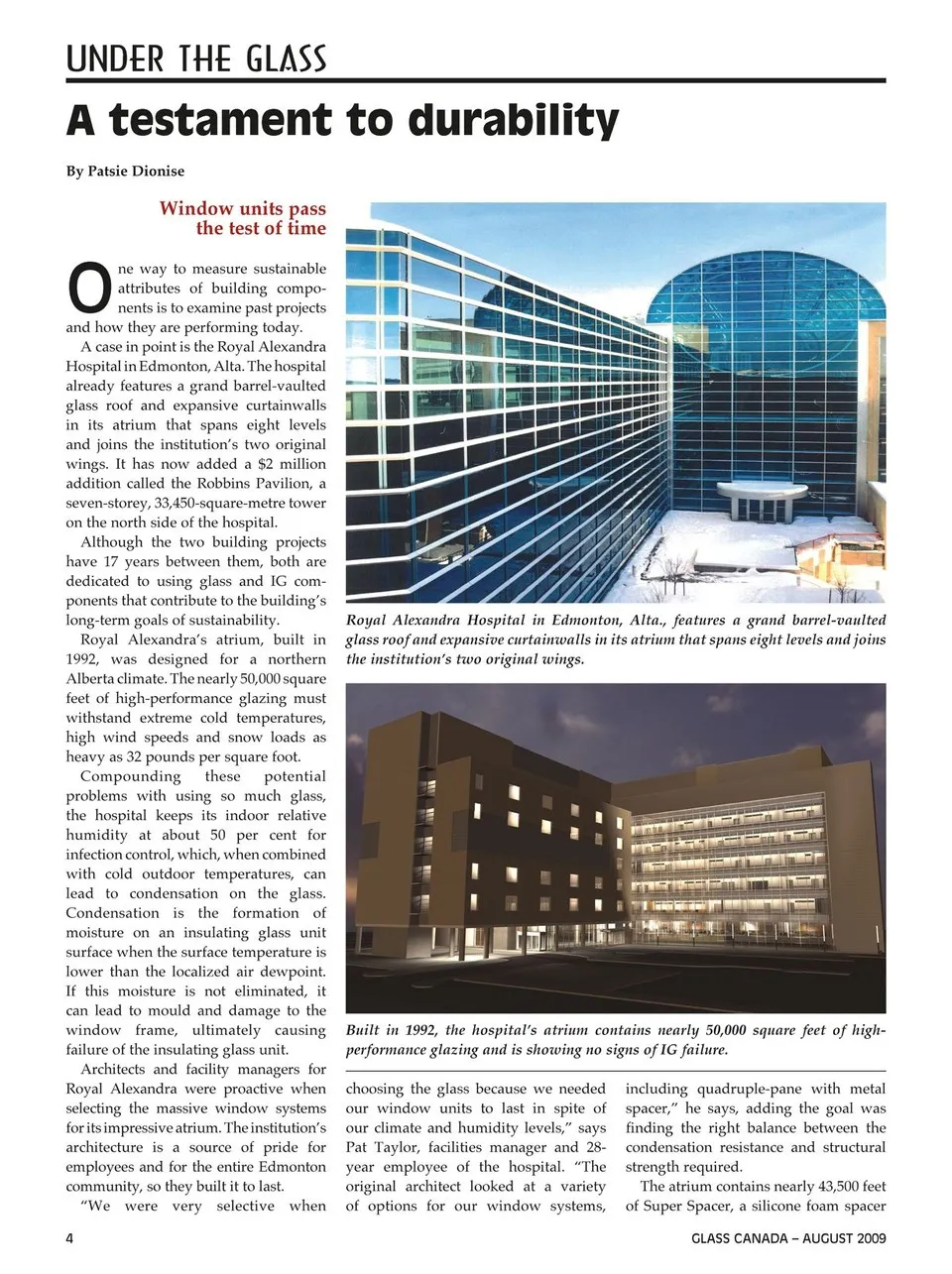
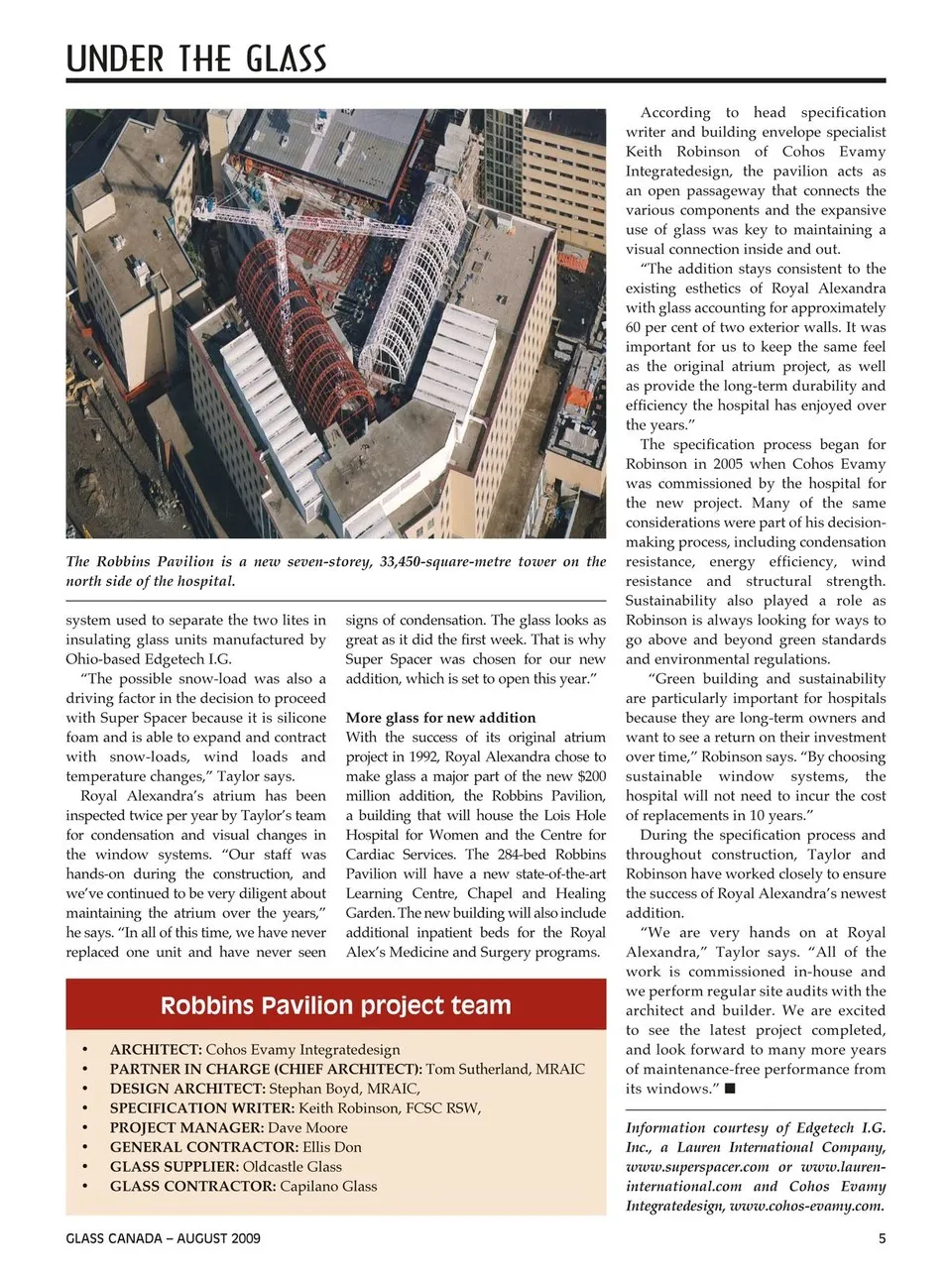
UNDER THE GLASS A testament to durability By Patsie Dionise Window units pass the test of time O ne way to measure sustainable attributes of building compo- nents is to examine past projects and how they are performing today. A case in point is the Royal Alexandra Hospital in Edmonton, Alta. The hospital already features a grand barrel-vaulted glass roof and expansive curtainwalls in its atrium that spans eight levels and joins the institution’s two original wings. It has now added a $2 million addition called the Robbins Pavilion, a seven-storey, 33,450-square-metre tower on the north side of the hospital. Although the two building projects have 17 years between them, both are dedicated to using glass and IG com- ponents that contribute to the building’s long-term goals of sustainability. Royal Alexandra’s atrium, built in 1992, was designed for a northern Alberta climate. The nearly 50,000 square feet of high-performance glazing must withstand extreme cold temperatures, high wind speeds and snow loads as heavy as 32 pounds per square foot. Compounding these potential problems with using so much glass, the hospital keeps its indoor relative humidity at about 50 per cent for infection control, which, when combined with cold outdoor temperatures, can lead to condensation on the glass. Condensation is the formation of moisture on an insulating glass unit surface when the surface temperature is lower than the localized air dewpoint. If this moisture is not eliminated, it can lead to mould and damage to the window frame, ultimately causing failure of the insulating glass unit. Architects and facility managers for Royal Alexandra were proactive when selecting the massive window systems for its impressive atrium. The institution’s architecture is a source of pride for employees and for the entire Edmonton community, so they built it to last. “We were very selective when 4 Royal Alexandra Hospital in Edmonton, Alta., features a grand barrel-vaulted glass roof and expansive curtainwalls in its atrium that spans eight levels and joins the institution’s two original wings. Built in 1992, the hospital’s atrium contains nearly 50,000 square feet of high- performance glazing and is showing no signs of IG failure. choosing the glass because we needed our window units to last in spite of our climate and humidity levels,” says Pat Taylor, facilities manager and 28- year employee of the hospital. “The original architect looked at a variety of options for our window systems, including quadruple-pane with metal spacer,” he says, adding the goal was finding the right balance between the condensation resistance and structural strength required. The atrium contains nearly 43,500 feet of Super Spacer, a silicone foam spacer GLASS CANADA – AuGuSt 2009
Glass Canada August 2009: Page 4